"For my Brother," a poem

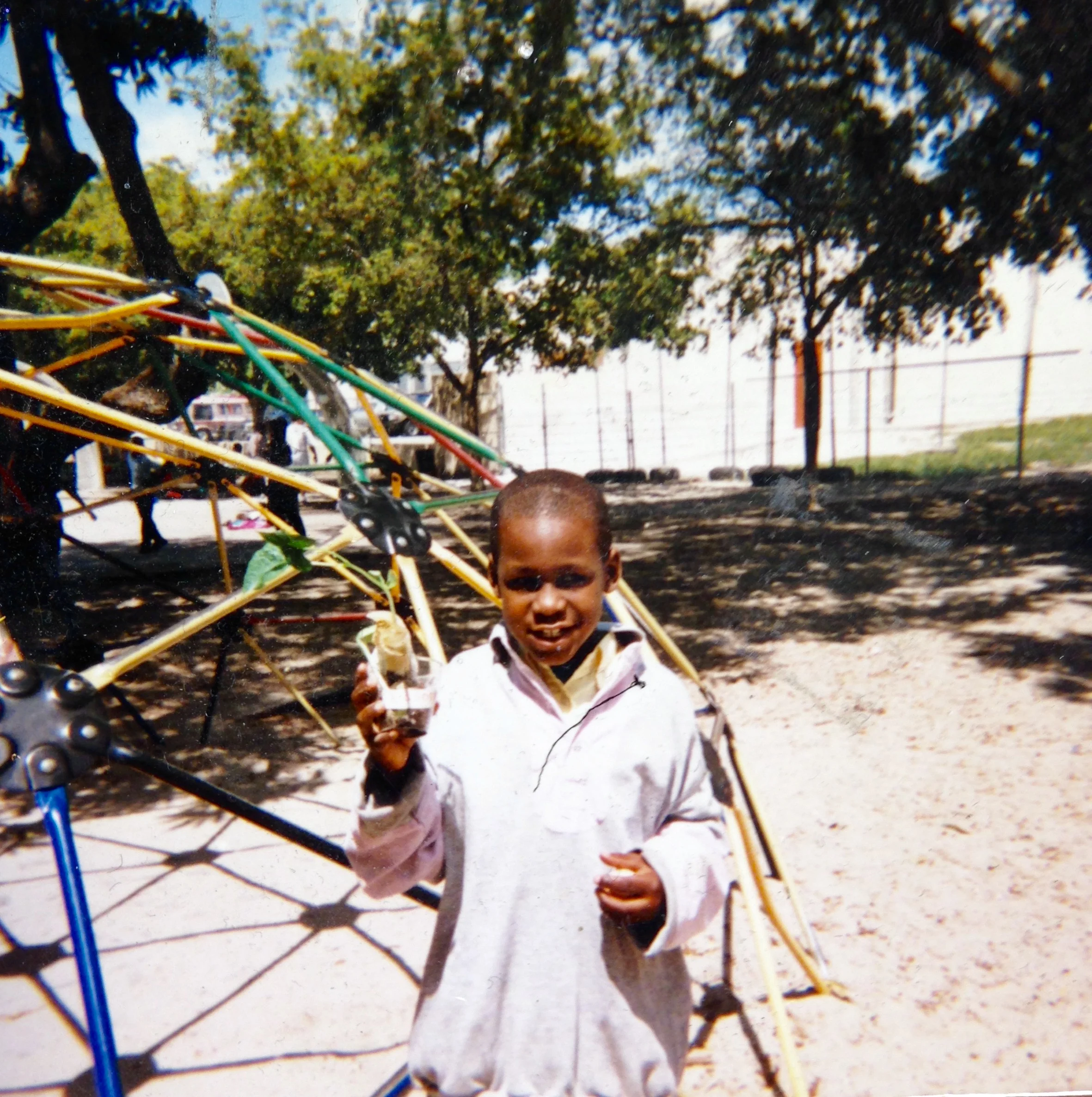
Yesterday, I wrote a poem about my brother being shot in January 2019. He was unarmed and shot while grocery shopping in Miami. Florida is a state that allows for people to carry guns and “Stand Your Ground.” The poem is a reflection on the ongoing state, vigilante, and gun violence against Black people in the United States. This is a picture of him as a young boy during the late 1990s in Miami, Florida.

My brother outside Toussaint L’Ouverture Elementary School in Miami, Florida during the late 1990s.

My brother outside Toussaint L’Ouverture Elementary School in Miami, Florida during the late 1990s.

For My Brother

Society has failed you

mostly because it is afraid of you

Of your tightly curled hair

with cornrows that are

neatly braided from the hands of the

people who care for you

Society fears you

because you stand six feet tall

like your grandfather

and his father

your strength is part of our

intergenerational survival

Society has ignored you

because it cannot appraise

your humanity

your intelligence

your insight

This is a failure on society’s part

They don’t know

the brother

the son

the friend

that loves climbing banyan fig trees

at Morningside Park on temperate days.

They don’t know

the brother

the son

the friend

that adores eating friend griot with pikliz and bunun

while switching between Haitian and English or

what we call Henglish

They don’t know

the brother

the son

the friend

who loves swimming in the Atlantic Ocean

hoping to reach the edge of the horizon

What society thinks it knows is a false vision

of

all

the

men

that look like

you

All the Black men who just want to

cry

laugh

walk

read

pray

breath

and

live.

Copyright Edna Bonhomme, February 2019.

Do Objects Speak?

“It is not a dead society that we want to revive. We leave that to those who go in for exoticism.”

-Aimé Césaire

Colonialism was capacious for those in power and rapacious for those who were colonized. During the Berlin Congress of 1884-1885, European countries orchestrated the partitioning of the African continent ranging from settler colonialism to protectorate rule. The Congress was not just one meeting but a series of conversations and debates regarding the boundaries and political outline of the African continent. Berlin was not only a site for colonial planning but it was also the locale where African colonial objects remain. The history of museum objects and their circulation is being re-evaluated by activists, artists, and scholars often calling for formal apologies and repatriation of materials.


Why this resurgence of interest in understanding German colonialism? How have Berlin based artists and activists engaged with this history?


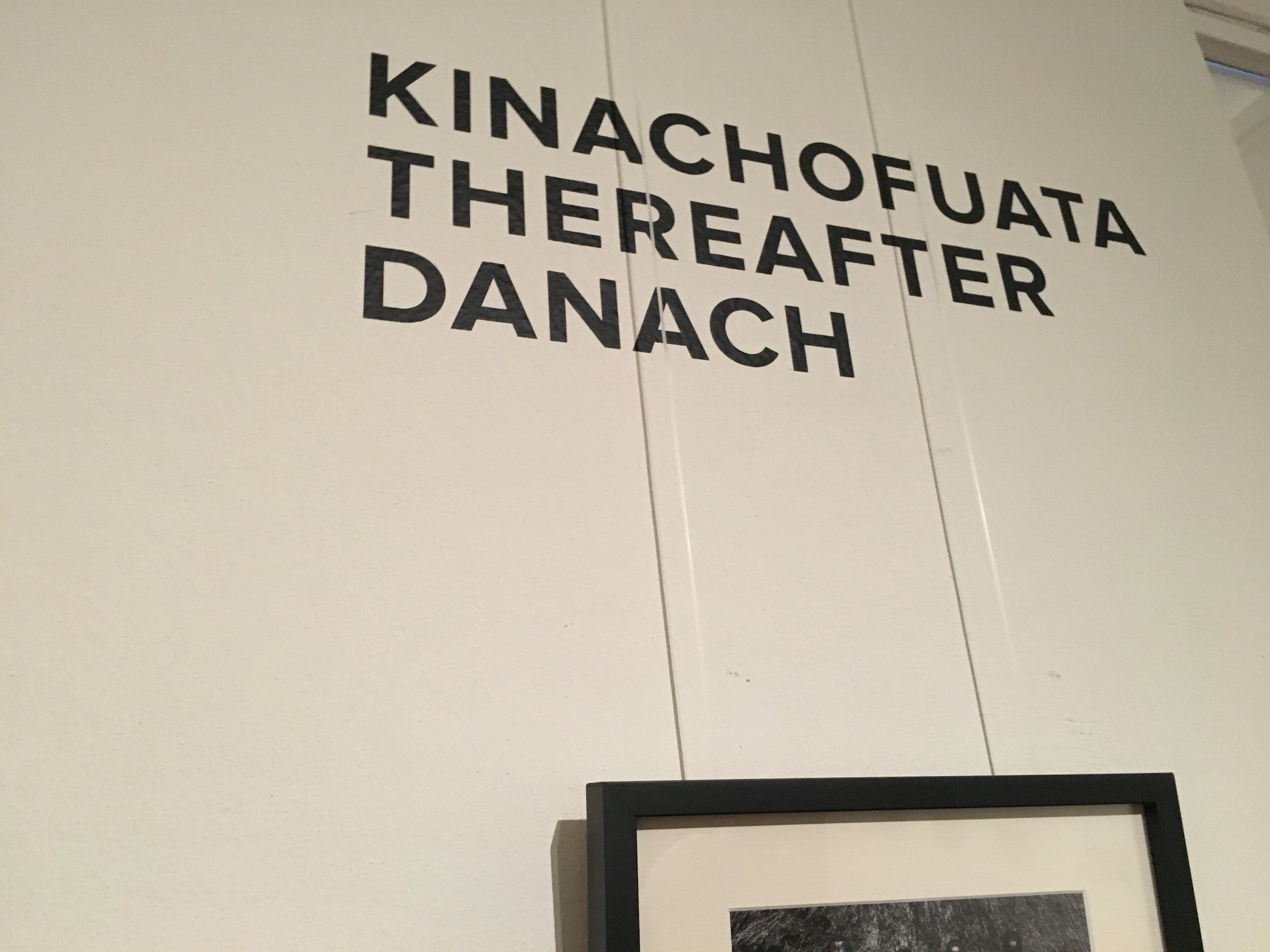
On 19 January, I visited the exhibit, “The Dead, As far as  [ ] Can Remember,” which invited viewers to convene with German colonialism on the African continent. The four-room exhibition was based at the Tieranatomisches Theatre (Animal Anatomy Theater) at the Humboldt University of Berlin. Positioned in the bustling neighbourhood of Mitte, the Tieranatomishces Theatre simultaneously functioned as an eighteenth century relic where laboratory experiments were performed and a place where historical memory was being reimagined. Each room was independently curated to engage with the legacy of European colonialism with a meditation on objects, folklore, testimonies, and expertise.

Photograph from “Chief Meli Remains”

Photograph from “Chief Meli Remains”


l“The Dead, As far as  [ ] Can Remember” used politics as an entry point but did not stop there. As I entered one room, the center of the room projected a grandfather’s tale on a broken ceramic, tiptoeing between an archeological and archival artifact. This room focused on an uprising led by Chief Meli, who opposed the German colonial occupation.


The exhibit begins with Chief Meli but it does not stop there. Rather, we come to get a glimpse of rural life, migration, and the shifting landscape of Chaggaland. One striking image are the passport pictures of five Chaggaland ambassadors who travelled to Germany in 1889 to meet the Kaiser. They were all male. One of them refused to meet the German leader. We learn about the brutality of Lt. Merker, the circulation of postcards with the marketplace of Tsunduni. It begs asking: Who were taking these photographs? By 1900, the German military forced sentenced Chief Meli and his collaborators to death. Part of what makes the exhibit harrowing is that their skulls were brought to Germany and still remains. The exhibition

Moving beyond these tales, one finds another room, which was concerned with access, digitization, and circulation. For some of the experts, the preservation of foreign objects somehow overshadows the concerns of the living. One researcher inquires: “Who benefits? Who do you do something for? Researchers are always welcome.” For him, experts should always have access yet he does not indicate their biases, their limits, and their positions. What one gathers from the interviews is that there is no consensus on the matter. Another scholar reflects a bit more about the political stakes by asserting: “We have a duty to be open and honest about things that are difficult.”


These tensions are precisely what give the “Just Listen” room such power. Repatriation and restructuring were taken up in the “Just Listen” segment that included the perspectives of people of colour and former colonial subjects. As Abdel Amine remarked, “We have to recognize that the bones come from humans.” This is precisely the humanity that is missing from the  Yet, even beyond that, these activists pointed out that the Humboldt Forum and the ethics concerning these objects. Yet, morality is not where it ends. A major element of the exhibition was restitution and the political elements of this. The people want reparations and the redistribution of wealth—from the former colonial power to the formerly colonized. These objects and their reception are part of an ongoing debate about history, memory, and retribution.


“The Dead, As far as  [ ] Can Remember”  exhibit will not solely live in Berlin, Germany, but it will find a home in Dar Es Salaam and Old Moshi in present-day Tanzania. Its circulation speaks volume to what is possible in shifting our understanding of history. For those concerned about the violent past, we do not only want to harp over the dead but to make space for the humanity of the living.

A Requiem for Rosa

“What do you want with these special Jewish pains? I feel as close to the wretched victims of the rubber plantations in Putamayo and the blacks of Africa with whose bodies the Europeans play ball… I have no special corner in my heart for the ghetto: I am at home in the entire world, where there are clouds and birds and human tears.” 
― Rosa Luxemburg


Berlin is a city haunted by its past. 1848, 1919, 1933, and 1989 are a series of dates that feature into several turning points for the left and right. The 15th of January marks the 100th anniversary of Rosa Luxemburg’s murder by the Freikorps, under the direction of the German Social Democratic Party. Rosa’s death is a requiem for the international Left especially given that our holidays are few and far between.


I first learned about Rosa Luxemburg in 2009 during in a Mass Strike reading group when I was living in Harlem, New York. Harlem is and was a neighborhood layered with the Black radical and literary tradition. Hence, it was no coincidence that the writings of a Jewish Polish Marxist would be acknowledged by Harlem residents. This was a place that Black Communists organized against rental hikes and the vilification of the Scottsboro boys in the 1930s. At the genesis of the economic crisis, New York City provided a political home for me to sharpen my socialist politics in the wake of capitalism’s failure.


Luxemburg’s reception has many lives. The Polish Jewish Marxist is lamented by orthodox Marxists and vilified by conservative social democratic tendencies. What is often missing from hagiographies and defamations is her political and personal complexity—a philosopher, and writer who strove for an international and anti-war socialist movement.


Through a convenience marriage, Rosa was granted German citizenship, which allowed her to live in Berlin during her political activities. For her, this city was a leftist mosaic for trade unionists, feminists, and communists. Berlin was her political home insofar that she had extant debates with her comrade Claire Zetkin and her opponent Eduard Bernstein. Rosa’s legacy survives through place and rhetoric, namely through the German Die Linke (Left) Party foundation appellation in her honor. In 2013, Verso Books published The Letters of Rosa Luxemburg, which shed light on her intimate and political commitments (https://www.versobooks.com/books/1441-the-letters-of-rosa-luxemburg). Historian Helen Scott has remarked:


“Luxemburg was a product of these times, but also an unusual degree acted upon them, fighting for socialism and against barbarism. And she left a rich legacy for others who have taken up the struggle.” (Helen Scott, Haymarket Books, 2008, page 2)


For many on the revolutionary left, her premature death was a waterloo for German and European socialism. Yet, it proceeded a failed revolution months early on November 2018.


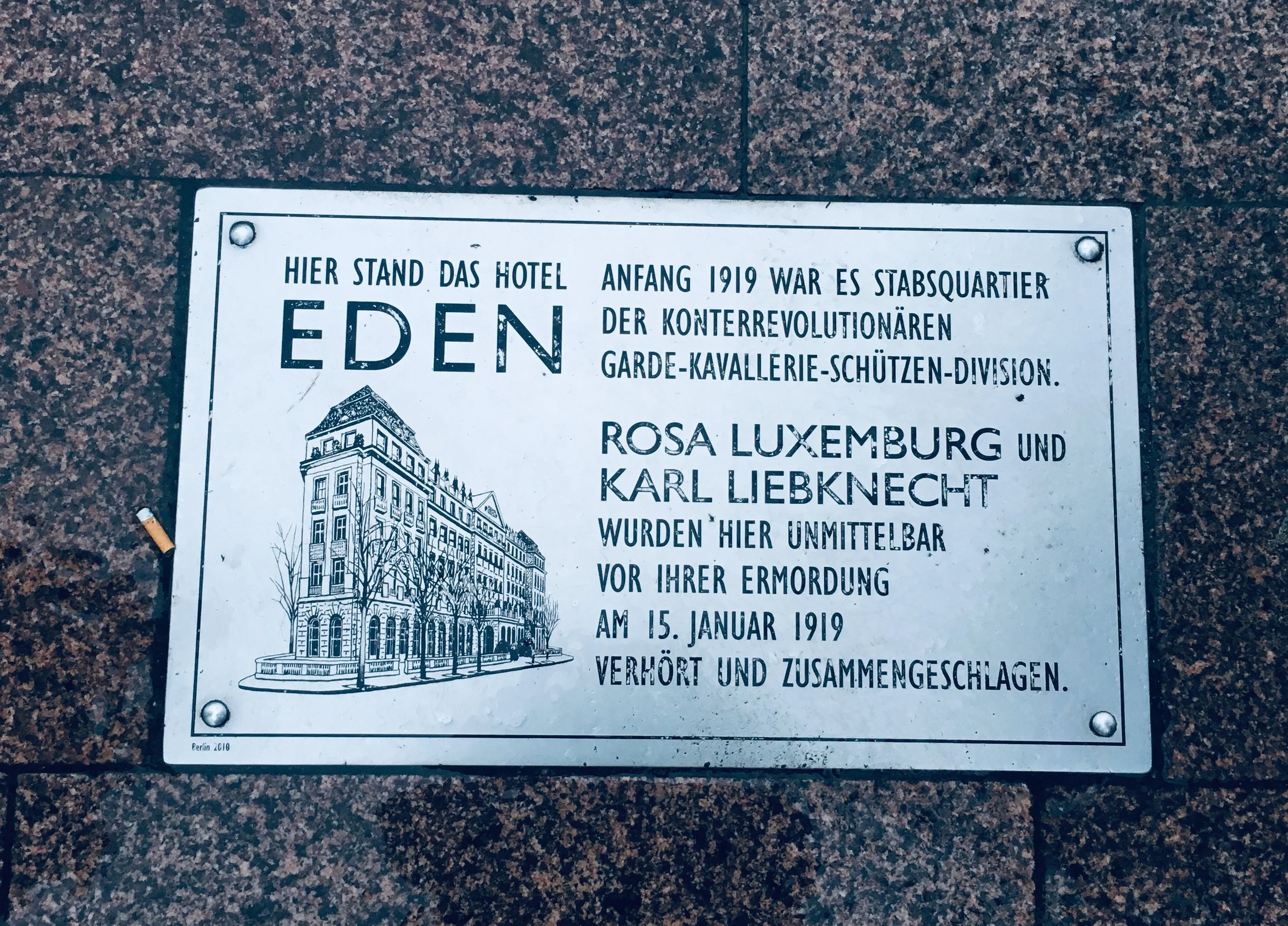
On 12 January 2019, I joined Ingar Solty and several other comrades on a tour traversing Rosa Luxemburg an Karl Liebknecht’s final days. We began on Budapeststrasse, opposite the Eden Hotel, where the Freikorps interrogated Karl and Rosa.

IMG_6425.jpg

Picture Taken 12 January 2019 on Budapestrasse, Berlin, Germany by author.

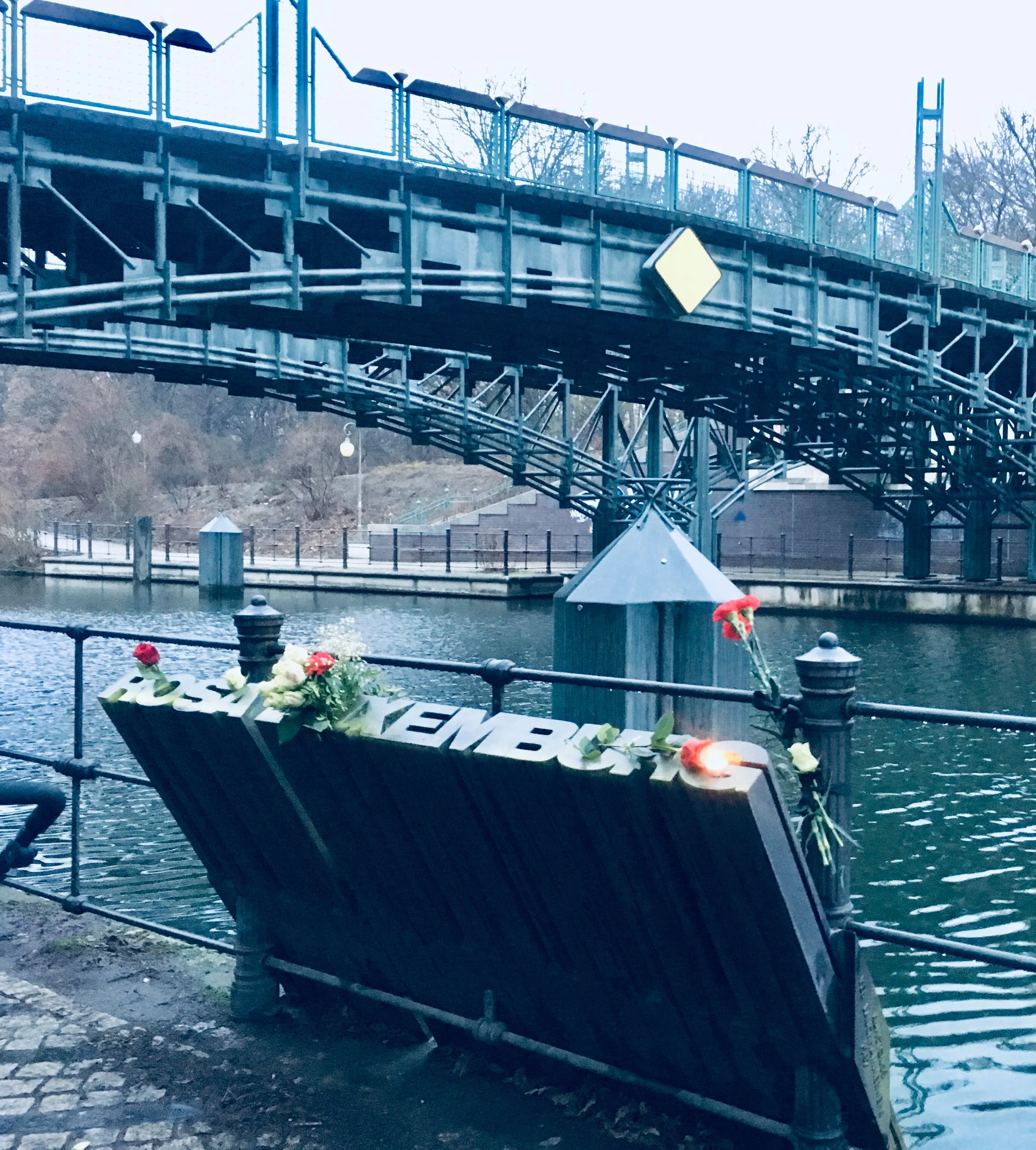
On that grey and wet afternoon, must like the day they were murdered, our group walked towards the Landwehr Canal. One hundred years ago, the group of men transporting Luxemburg, shot her and eventually threw her body in the canal.

IMG_6427.jpg

Picture taken on 12 January 2019 on Budapestrasse, Berlin, Germany by author. 

Her body remained frozen in the canal for several months—probably frozen by the long and protracted winter of 1919. Today, a monument is erected from the edge of the canal, with Rosa Luxemburg’s name bulging from the iron railing. This memorial is reminder of the political crises she relayed to Clara Zetkin, her friend and confidant on 11 January 1919:


 “The severe political crises that we’ve experienced here in Berlin during all of the past two weeks or even longer have blocked the way to the systematic organizational work of training our recruits, but at the same time these events are a tremendous school for the masses. And finally, one must take history as it comes, whatever course it takes. —The fact that you are receiving Rote Fahne so infrequently is disastrous! I will see to it that I personally send it to you every day. —At this moment in Berlin the battles are continuing.802 Many of our brave lads have fallen. Meyer, Ledebour, and (we fear) Leo [Jogiches] have been arrested. For today, I have to close. I embrace you a thousand times, your R.” (Rosa Luxemburg. The Letters of Rosa Luxemburg, Verso Books, 2013)


One can take the history as it comes, and one can also use that history to shape a more radical and equitable future.


227 years fighting power: Ta-Nehisi Coates and the Specter of Black Internationalism


I wish you could know

What it means to be me

Then you’d see and agree

That every man should be free

-“I Wish I Knew How it Would Feel to Be Free”


In 1967, Nina Simone performed “I wish I knew How it Would Feel to be Free,” which was popularized during the Civil Rights movement. The song resonates with those who have felt the omnipotent pressures of being shackled and silenced by society. The ballad echoes with those who yearned for freedom and envisioned soaring through the sky—yet it renders freedom as a fleeting and impossible dream. That aura unfurls in Ta-Nehisi Coates’s We Were Eight Years In Power:  An American Tragedy. For Coates, racism’s salience weaves throughout his text, opining a Manichean perspective on trauma in Black America. Yet, Coates’ pessimism does not emerge from vacuity but it emanates from his experience of growing up Black in America—on the edges of a Civil Rights movement and at the locus of poverty.


Ta-Nehisi Coates was raised in a segregated, mostly Black neighborhood in Baltimore, Maryland—the location of the popularly known TV series, The Wire. As of 2015, 17% of Black people in Baltimore were living in concentrated poverty compared to 2% of white people living in Baltimore. Black poverty is not random but it is by design—mostly part of the aftermath of systematic anti-Black discrimination in education, housing, and labor. For the formative years of his life, Coates moved through a world where Black poverty was visible and destructive. Yet, this was on the heels of Black resistance and the erasure of legal segregation, popularly known as Jim Crow. His father, William Paul Coates, was a member of the Black Panther Party, a Marxist revolutionary group that added a material nature to the Black power movement during the 1960s and 1970s. The augmentation of Black poverty and the implosion of Black radical struggle are factors that explain Coates’s worldview—and they surface throughout We Were Eights Years in Power.


Unbeknownst to Coates, his book sparked a dynamic debate in the United States about racism, class, and resistance. The most polemical critique arose from the acclaimed Harvard University Professor Cornel West who characterized Coates as part of a “neoliberal wing that sounds militant about white supremacy but renders black fight back invisible.” Although West’s tone and mannerism were strident, leaving Coates to abandon Twitter, West is (rightly) concerned about the gaps in Coates’ book for not directly taking on capitalism, patriarchy, and homophobia. The Marxist historian Robin D.G. Kelley provided a sober rejoinder to the Coates-West debate by pointing to the long tradition of Black American scholars, with Booker T. Washington and W.E.B. Dubois serving as the archetype of the liberal-radical divide. As Naomi Klein and Opal Tomati have noted, books cannot address all of our concerns but they can provide the space to understand parallels between racism in the United States and the tentacles of American imperialism abroad.


That debate concerning We Were Eight Years in Power is sparking deeper questions about black liberation and internationalism and it is providing the space for people to inquire about "sources of resistance" not just in the United States but also on a global scale. Political debates can provide the space to heighten strategy and tactics and a major critique, among the left, concerning We Were Eight Years in Power is that the pessimistic framework within the text elides the mass struggle by oppressed people around the world. The text falls short but not for the reasons that West describes, but rather, for its insularity. How do we reckon with Black intellectual thought that overshadows the voices of the oppressed and the contributions freedom fighters? What does it mean to write about the state of Black politics and Black self-determination in the current moment?


Eight Years in Power

We Were Eight Years in Power is a diachronic history of race relations in the United States told through framework of Ta-Nehisi Coates’ development as a writer. The eight chapters in the book glide through the Civil War period, the Civil Rights movement, and the Barack Obama administration. Not only does Coates provides snapshots of Black enslavement, mass incarceration and racial segregation, he tries to explain where his starting point was and how white supremacy is the political legacy of the United States.  


We Were Eight Years in Power shows the limits of a Black nationalist framework and what an internationalist one can offer in expanding our horizon for justice. While Coates is notable for having criticized liberal politics at the height of Barack Obama's presidency, this led him to radical demands, principally that for reparations. Coates lack of a thorough class analysis has to do with two monsters of class erasure: the attacks of US government on the leftist struggles and the failure of the left to grow with newly radical people.


There are gestures to radical politics but they fall short in describing the opposition to Black struggle. When Coates argues, “…there is the actual enslavement and all that has followed from it, from Reconstruction to Jim Crow to mass incarceration,” he is invoking the work of Michelle Alexander’s The New Jim Crow. [1] In the footnotes, Coates praises her contributions but affirms that mass incarceration is “appropriate only if you already believe that certain people weren’t really fit for freedom in the first place.” This affirmation rests on an ideological perspective on discrimination—not one built on the capital and profit that emerges from slavery and mass incarceration. At the same, he acknowledges that reading Michelle Alexander’s work shifted his consciousness because it provided the foundation and language to understand the sociological and economic conditions for racism.

Coates departure from the immaterial realms of hatred towards the material impact of racism is most grounded in his chapter “The Case for Reparations.” It is here that he turns away from liberalism and make direct links between anti-Black discrimination and capital. He writes:

“Since the country’s wealth was distributed along the lines of race and because black families were cordoned off, resources accrued and compounded for whites while relative poverty accrued for blacks. And so it was not simply that black people were more likely to be poor but that black people—of all classes were more likely to live in poor neighborhoods.”


It is at this moment that he articulates his political development from a person who opposed reparations into someone who advocated for it. He provides ethnographic accounts that vividly show how African American families went from being slaves to sharecroppers to indebted. By advocating for reparations, he wants to elide white guilt and replace it with redistribution of wealth—something that could extend to the working class as a whole. The aforementioned quote matters because it shows—contrary to West’s critique—that Coates is slowly developing an analysis about the relationship between race and class and that he is doing so through a rigorous case study. Even further, it shows that a shift in political consciousness is possible when the texts, voices, and lives of the Black working class are made palpable.


These hints of trauma and strength were also overshadowed from what Haitian American acclaimed writer Roxane Gay described as “a glaring absence of reckoning with the intersection of race and gender.” This begs the question, how did Black women contribute and change the world? How does history writing take a feminist perspective? As the historian Robyn V. Spencer writes, “History is not fiction but the mechanisms that silence Black women’s intellectual production even while seeming to herald their numerical presence is present in each realm.” The narrative that Coates offers presents Black women’s suffering and their occasional resistance but not their intellectual production. It is not enough to bring Black women in because they are missing, but it is necessary because they import a particular virtuosity stemming from their insights.


In “Notes from the Fifth Year,” Coates places his ideology to the legacy of Black women who resisted slavery and Jim Crow segregation. One ancestor was Celia, a Black enslaved woman who was hung for murdering her white slave owner. Another forebear was the African American journalist and organizer, Ida B. Wells, who led anti-lynching and anti-rape campaigns. While these women endured, they are positioned in isolation, as if they operated on their own. The text falls short of including the Black women who played a significant role in broad-based movements such as: the Haymarket rebellion, Socialist Party, trade unions, and the free Scottsboro movement. It warrants pointing to their contributions because they were not separate from progressive change but they were integral to the liberation process in the United States, yet their version of freedom, their truth, and their loves are overwhelming omitted.


Internationalism

Coates presents a story about Black America to the exclusion of the African diaspora in North America, Central America, South America, and the Caribbean. The Americas rest on the ghosts of indigenous groups that were murdered by Europeans and on the blood of African slaves who toiled the land. These are perilous histories that have mutated into a living nightmare that continue to haunt Black people from Brazil to Puerto Rico.


Politics and political imagination needs the space and time for people to reflect on their vision of the world, which are present in visionaries like Claudia Jones, Aimé Césaire, and Frantz Fanon. Like Coates, these Black Caribbean scholars were descendants of the Trans-Atlantic slave trade. Unlike Coates, they were grounded in in an internationalist Black radical tradition rather than a parochial Black Nationalist tradition. Black intellectual thought and radicalism is a work in progress insofar that the political moment can inspire people to collectively organize for their liberation and to dream for other futures.


The move towards internationalism emerges in Coates when he speaks of Malcolm X’s political shift. He writes, “As Malcolm traveled to Africa and the Middle East, as he debated at Oxford and Harvard, he encountered a torrent of new ideas, new ways of thinking that batted him back and forth.”[2] What one gathers is that internationalism—something that Malcolm X and the Black Panther Party flirted with—allowed the space for radicals to move beyond borders imposed upon them and to imagine the dynamics of social struggle. The Black Panther Party, of which Coates’ father was a member, was a group that reached international lines and was a symbol of resistance amongst Algerians during the postcolonial moment and Maori who resisted white settler colonialism in New Zealdn. Given Coates’ direct link to the Black Panther Party, it is no coincidence that he was integral to the reemergence and popularization of the Marvel Black Panther comic, and subsequently the film. The Black Panther motion picture has generated a host of commentary by intersectional theorists, leftists, and postcolonial scholars. While the film does not fully appeal to the radical tenure of the comics—as Professor Christopher Lebron notes—it has opened a set of questions about the legacy of the Black Panther Party, Afrofuturism, and the limits of isolationist policies. Coates made Black Panther in its current cultural iteration possible, but it should not end there.


From Afropessimism and Black Nationalism to Afrofuturism and Black Internationalism

In We Were Eight Years in Power, Coates is less concerned about moments of resistance and possibility and more about how a hegemonic white America imposes its hate on Black Americans. The goal of the Left is to give social movements a historical materialist framework that captures the real lessons from freedom fighters around the world, rather than providing broad and superficial strokes that pit class and race against each other. The Black Marxist C.L.R. James astutely described the power of the Haitian Revolution and liberation in The Black Jacobins,


The transformation of slaves, trembling in hundreds before a single white man, into a people able to organize themselves and defeat the most powerful European nations of their day, is one of the great epics of revolutionary struggle and achievement. Why and how this happened is the theme of this book.[3]


History writing is a ceaseless activity that accumulates the tragedies with the moments of liberation, yet the insurrection of Black slaves in San Domingue altered the course of chattel slavery in the Americas and offered liberation to other Latin American countries. Delving into resistance allows the space for society to collectively recognize past crimes, acknowledge the contributions of non-elites, and honor the gains that were made. In doing so we begin to find hope for resistance from what society would consider the unlikeliest sources, be it Black slaves who freed themselves, Claudia Jones, Ella Baker, or Angela Davis.


The notion of liberation was pioneered by the Combahee River Collective whose contributions the American Left is returning to. What made them exceptional was that they were marginal subjects (Black working class lesbian women) who not only recognized the material conditions of their situation but they acknowledged that collective action through political education and organization were necessary precursors for the entirety of the working class. Yet, even further, they offer a corrective to feminist and antiracist struggles by suggesting, as titled in their new book How We Get Free, the necessary conditions for building resistance from below.


If we want to do justice to an obscured history and provide concrete solutions so that we may be free, that means finding those volcanic eruptions of struggle from below—not just on US soil but on an international scale. Borders sully international resistance—and capitalism’s ability to conquer and divide has metasized oppression especially among refugees, transgender people, and those living under war. Much can be learned from Afrofuturism and the possibilities that it offers—its proponents invite us to imagine a world where Black people are able to dream and create a world that through the arts, sciences, and beyond. When Afrofuturism is put into practice it gives hope. If we take Afrofuturism and internationalism seriously and make it a part of Black radical politics that means envisaging a world where we not only demonstrate how society is molded but how everyone can be free.


[1] Coates, p. 111-112

[2] Coates, p. 100

[3] p. ix
8415279256_622f3f3a02_o.jpg

Searching for Fanon

On 1 November 1958, Frantz Fanon contributed to El Moudjahid by making the following claim:

The independence of a new territory, the liberation of a new peoples are felt by the other oppressed countries as an invitation, an encouragement, and a promise. Every setback of colonial domination in America or in Asia strengthens the national will of the African peoples. It is in the national struggle against the oppressor that colonized peoples have discovered, concretely, the solidarity of the colonialist bloc and the necessary interdependence of the liberation movements.

The FLN moved their headquarters from Algiers to Tunis in 1956.2 Shortly after, Fanon wrote for the publication El Moudjahid, travelled as a delegate to various anti-colonial conferences in Accra and Cairo. He not only theorized about the anti-colonial movement in Algeria, but he was actively participating by publishing articles and engaging with revolutionary activity.

The son of a Black middle class Martinican famiy, Fanon excelled alongside his peer Aimé Césaire which provided them the opportunity to acquire an education in the metropole: Paris. While I was re-reading Frantz Fanon I was struck that Fanon spent the last several years of his life in Tunis—a direct product of his involvement with the Front de Libération nationale (FLN). Fanon saw institutions such as the Bandung pact as necessary steps to provide the material and ideological dimensions for the anti-colonial struggle.

During the final years of his life, he wrote The Wretched of the Earth while living in Tunis. Fanon connected his own life and history not only to the Black people on the African content, but to various people who were struggling for independence. His political trajectory, albeit circuitous, was a product of the international delegations and struggles that were brewing.

Given Fanon’s involvement, I was curious to learn the extent to which Arab and Black revolutionaries were systematically engaged in ideological, material, and political movements in North Africa. Were anti-colonial struggles merely concerned about the nationalist question or was there something more internationalist about these liberation struggles? How did Marxist perspectives on the nationalist question feature into these political movements? Was there a sense that anti-colonial invoked proletariat internationalism?

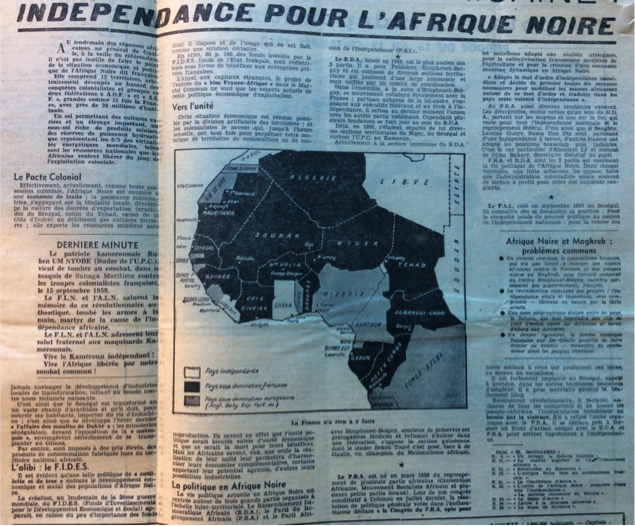
Afro-Arab solidarity was not merely a function of rhetoric but it was tied to material support at the national level. What this resulted in was that leaders and activists were able to convene in North Africa to discuss political strategies for independence and self-determination. Publications such as El Moudjahid represented one of many platforms where seasoned activists could display their call to action (Figure 1).

Arab and Black figures were collaborating and coordinating against colonial interests through intellectual realm, political delegations, and solidarity statements. El Moujahid was a publication and a political platform that helped to solidify Afro-Arab solidarity during the colonial period (Figure 2). It reads on the left hand side: “Vive le Kameroun indépendant! Vive l’Afrique libéré par notre combat commun!” “Long Live an independent Cameroon! Long live a Free Africa for our common fight!”

In another issue, there was an attempt to point to the liberation of Arab nations as well (Figure 3). By the 1960s, the dynamics between Arab and Black Africans shifted according to the local context where in some cases the relations were purely political and in others there were cultural and personal ties. What hap begun as overt operations to European colonialism festered into nationalist programs thus moving further away from the radical, internationalist tradition of the mid-1950s. Fanon never lived to see Algerian independence. However, his tenacity and legacy persist mostly because he dared to envision a world where Arabs and Blacks could be free.


El Moudjahid. 1958. Cover of El-Moudjahid. It reads Africa for Africans and it has Ako Adjei, Ghana’s Minister of Labor, M’hamed Yasid, Algerian Minister of Information; C.H. Chapman Togo minister;  D.A. Chapman, Ambassador of Ghana to the UN
El Moujahid: Independence for Black Africa. They describe a colonial pact and its impact on the region. Black marks the countries that were colonized by the French. Grey colonizes by the British and White were independent.
El Moujahid. Tomorrow for the Arab Nations. This goes into detail about Arab countries, their demographics, etc

Sontag: 1933-2004

Susan Rosenblatt (popularly known as Susan Sontag) was born on 16 January, the year the Nazis came to power. Sontag’s family were Lithuanian and Polish Jews who found solace in New York City, a haven for African Americans escaping the Jim Crow American South and Southern and Eastern Europeans fleeing from famine and pogroms. Her cosmopolitanism fueled her literary acuteness and her willingness to understand the human experience furthered her political crusades.


Sontag’s literary genius was demonstrated in the range of texts she produced. From commentaries on war to meditations on health, she wrote an endless number of texts that dared to be serious and pensive.


In 1968, she went to Hanoi and eventually visited Vietcong. After conducting an investigative trip she reached the conclusion that “The Vietnamese are ‘whole’ human beings, not ‘split’ as we are.” They were whole because they resisted US militarization; Americans were not, because they could not understand the Vietnamese humanity.


On the history of medicine, Sontag showed that pathogens are biological but how we cope with them is political. When we navigate through a cold, cough, or headache, our bodily discomfort and our ability to transcend those feelings comes from the community and healing practices that deem fit. Originally published in 1978, Illness as Metaphor argues that the metaphors of cancer come from warfare not economics which goes to show how society normalizes disease but also uses disease imagery in political rhetoric to create of hierarchy of life and death. Tuberculosis, a nineteenth century disease was romanticized. In contrast, cancer coarsens the body and the soul with each malignant cell being a gateway to self-destruction.  


Staying with the theme of health, Sontag opted for a discussion on collective suffering in AIDS and its metaphors. It was here that the dimensions of the HIV/AIDS epidemic engulfed her community and loved ones. Yet, disease was not merely an allegory but rife with the panoply of death, an ascension of bodies whose talents, dreams, and loves would wither. Her outcry about the disease led to her vilification by religious conservatives in the United States. Their names: Pat Buchanan, Jerry Falwell, Norman Podhoretz.


Sontag was regal, verbose, and a modernist and her analysis about war and health offer an intimate portrait on humanity and its demise. At the same time, it showed her capacity to uncover her close encounters with death and her capacity to mourn.

Sontag smoking cig.jpeg